
Identity Is Not a Damage Meter
Resist the reassuring single number
A story about bodily modification often invites a meter that decreases whenever the character accepts a new capability. Such a meter is easy to understand, but it can also settle the central question before the player has made a meaningful choice. If every graft subtracts humanity, the interface has already declared what the change means. Geneowl’s biopunk concepts take another direction. We want the player to consider relationships, responsibilities and preferences without reducing a person’s identity to the amount of original tissue they retain.
Describe the decision in concrete terms
For a proposed gripping graft, the immediate choice concerns a new route, an occupied arm and a recovery interval. For a sensory graft, it concerns access to another kind of signal and the attention needed to interpret it. These consequences can be explained before commitment. They do not need an additional moral score to become significant. The character may welcome one change and dislike another for reasons that are expressed through dialogue and action. Neither response must be presented as the universal answer for every person in the setting.
Let other characters disagree specifically
A maintenance worker might value the runaway’s ability to reach a difficult seam while worrying about whether the tool has had time to recover. A companion might miss a familiar gesture that the new grip makes awkward. These reactions refer to observable situations. They should not turn every encounter into a generic speech about becoming less human. Specific disagreement gives the player something to respond to: explain a choice, adjust a plan, accept a boundary or seek another route. The relationship develops through those responses rather than through a hidden approval total.
Removal needs an honest description
If a tool can be removed, its interface should explain the practical process and the alternatives available afterward. Reversibility does not mean that every narrative consequence disappears, but it should mean what the game says it means. A player should not accept a graft on the promise of removal and later discover an unannounced permanent mechanical penalty. Where a consequence truly cannot be reversed, that uncertainty deserves explicit treatment before the choice. This is a design commitment for the concept, not a claim that all such systems have already been implemented.
Avoid making refusal an empty gesture
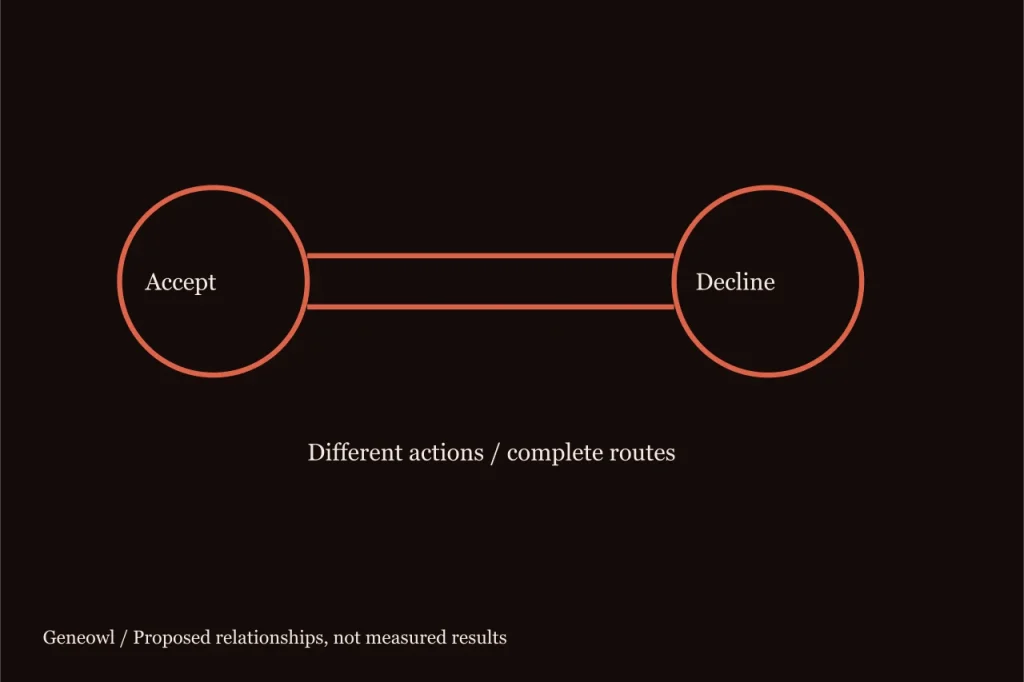
The option to decline a graft is not meaningful if every subsequent obstacle requires it. A no-graft approach should have its own complete route and legible decisions. It may involve different timing, another conversation or a longer path, but it should not consist solely of waiting for someone else to solve the level. Equally, accepting a tool should not erase the need to think. A new sense offers observations that still require interpretation; a new grip opens surfaces that still have physical limits. Both approaches deserve active participation.
Keep the record about events
A journal can note that the character used a sensory frill to follow a pulse, promised to return a cultivated sample, or chose the service passage instead of the balcony. Those records preserve decisions without assigning a permanent personality label. Later dialogue can refer to an actual event. This makes consequences easier to understand and avoids a system that quietly translates one practical choice into an unrelated moral identity. The player should be able to recognise why a conversation refers to something they did.
A useful boundary for the concept
We are not presenting these fictional grafts as medical advice or making claims about real assistive technology. They are a way to explore agency in a speculative setting. A future prototype would need to check whether its language respects that distinction and whether players can describe the consequences without assuming a hidden humanity score exists. The Borrowed Skin concept outlines the core choices. Our route study supplies a concrete example of how acceptance and refusal can each lead to a complete encounter.