
A Graft Should Change the Question
What does the new hand ask?
A climbing organ could be introduced as a simple improvement: attach it, reach a higher ledge, continue. That structure tells the player that modification is an admission ticket. For Borrowed Skin, we want to investigate a more interesting arrangement. The organ should change which questions a route presents, while an alternative route remains available. A player who declines the graft should encounter a different sequence of decisions, not a locked door labelled as personal freedom. This note describes a proposed encounter, not a completed playtest result.
Put both approaches in the same view
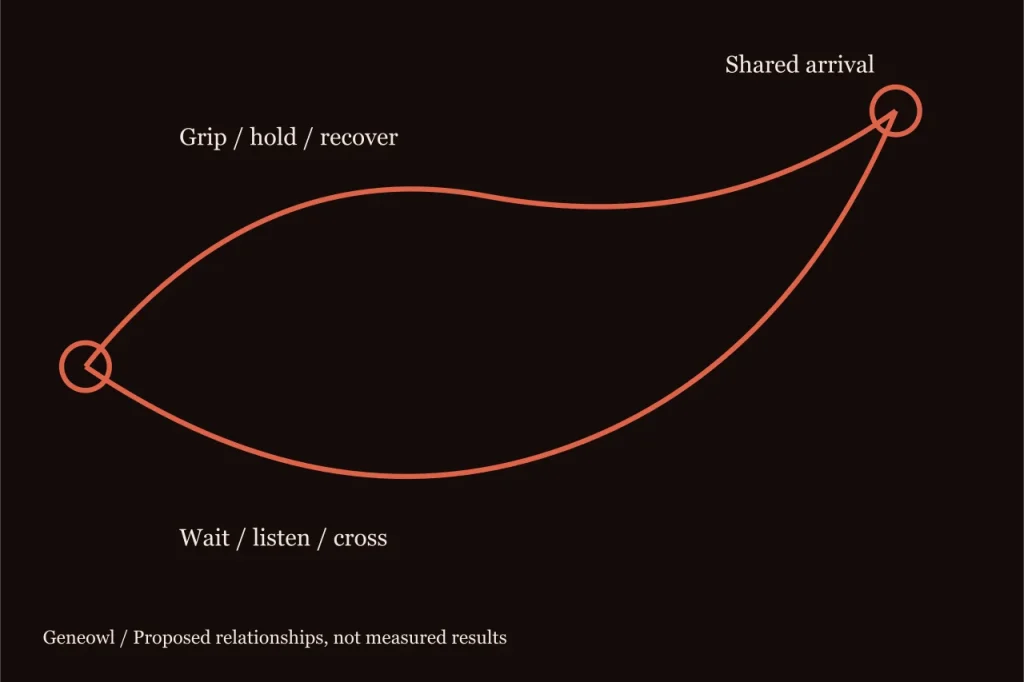
Consider a courtyard with a flexible support rising through its centre. A gripping graft can use the support to reach a balcony. A ground passage takes longer and passes a listening membrane that reacts to footsteps. From the entrance, both destinations should be legible. The balcony cannot be hidden until the player accepts the graft, because that would make the decision depend on information supplied only after commitment. An illustrated route preview can show the relevant surfaces without revealing every detail of the encounter beyond them.
Make the cost local
The proposed graft holds securely but occupies one arm while resting. That changes how the character carries a loose sample or steadies themselves on another surface. The consequence belongs to the physical situation, rather than an abstract penalty called lost humanity. Before installation, the player can examine a short demonstration that shows a grip, a release and a recovery interval. The demonstration should also show an unsuccessful hold in a safe space. Knowing how a tool stops working is as important as seeing its most impressive use.
Let refusal produce a complete encounter
The ground passage needs its own readable rhythm. A listening membrane might become less sensitive when a ventilation pouch opens, giving the player a visible cue for crossing. This route should not be a punishment corridor filled with extra chores. It offers another kind of attention: watching a shared environmental cycle rather than managing an attached organ. Both routes could meet at the same balcony entrance. Their differences then remain understandable without requiring two entirely separate chapters or declaring one character build the correct interpretation of the story.
Recovery is part of navigation
If the graft needs a pause after a sustained hold, the landing area should provide a place to wait. A recovery interval becomes unfair when the game demands another immediate climb without warning. We would mark reliable resting surfaces in the same visual language used during the demonstration. A player can then plan a sequence of short holds or choose the longer ground route. The objective is not to make every movement uncertain. It is to connect preparation, action and recovery so that the tool feels alive without becoming arbitrary.
Do not confuse reversibility with no consequences
Removing a graft could return a capability slot, but it should not silently erase every relationship the player formed while carrying it. A cultivated passage may still remember a scent; a guide may still refer to an earlier choice. Those are possible narrative consequences, not claims about real biology. Mechanical reversibility needs a clear description: where removal is available, whether a temporary recovery state follows, and which routes remain accessible afterward. The player should never discover that a supposedly reversible choice strands the character beyond the only exit.
Questions for a future prototype
The first useful evaluation would ask whether a reader can explain both routes before choosing, identify the recovery cue, and describe one reason to refuse the tool without assuming they are playing incorrectly. That is a design checklist rather than evidence that testing has already happened. The Borrowed Skin dossier gives the wider movement loop. Our note on presenting unfamiliar senses considers another part of the same problem: information should support a decision, not arrive as an unexplained answer after it is too late.