
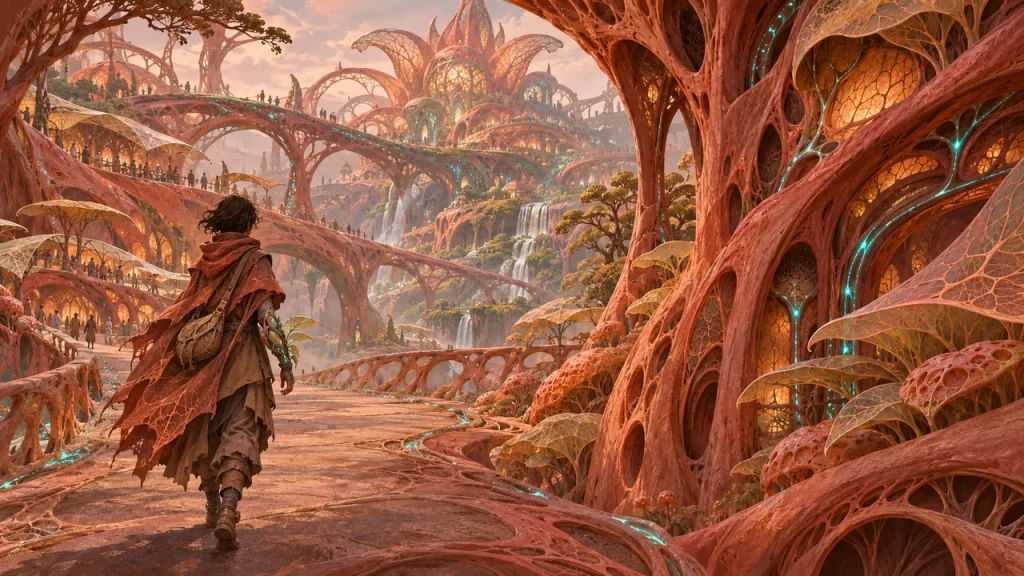
Borrowed Skin begins with a biotech runaway entering a cultivated district called the Fold. The buildings are not simply covered in vegetation. Their passages, supports and doors are grown for particular relationships with the people who use them. The character arrives without sharing all those relationships. Players would decide which living tools to accept, which routes to attempt and which forms of dependence they are willing to carry. This is a game concept, not a released title or a description of real biological procedures.
Observe before changing
The proposed navigation loop starts with a place rather than an upgrade screen. A passage reveals several possible approaches: a gripping route across a ribbed wall, a narrow maintenance channel or a longer public crossing. Each approach has conditions that can be investigated before the character commits. The player should understand why a graft might help and what alternative exists if they decline it.
Observation would identify practical features without declaring one route morally superior. The direct crossing may be convenient but require a tool with recovery needs. The longer crossing may expose the character to other obstacles. Choosing between them should reflect the player’s priorities and current situation. It should not amount to finding the route that the designer secretly considers the correct expression of humanity.
Carry a capability beyond its first use
A living grip is useful at the wall where it is introduced, but the design asks what it means in the next room. Its folded shape may affect a narrow passage. Its fatigue may change when the character wants to rest. Its sensory response may reveal something about a surface that an ordinary hand would not notice. These consequences connect the tool to ongoing play instead of ending at the moment it unlocks a door.
The proposal avoids a universal humanity score. A visible body change is not treated as a loss of personhood. Characters can have reasons to welcome, reject or reconsider a modification without being placed on a single moral scale. The player’s agency comes from understandable choices and opportunities to revise them, not from a meter that judges appearance.
The Fold as a navigable place
The district uses broad terracotta arches and narrow layers of flexible growth. Main routes remain readable through repeated structural cues, while optional passages interrupt those cues in ways a player can inspect. Cyan responses are reserved for selected living interfaces rather than spread across every surface. The art direction should make an unfamiliar city coherent enough to navigate without making every organism look like an illuminated button.
Recovery creates a rhythm
Tools need intervals in which they are not operating at full capacity. We are exploring recovery states that change available actions without stranding the player in compulsory waiting. A tired grip might support a short crossing but not a sustained climb. A quieter route could give it time to recover while still moving the journey forward. Those possibilities need careful investigation before any timing or balance claim is made.
Design priorities
The concept prioritises informed consent within its fiction, legible consequences and alternatives that remain worth considering. It still needs a clear answer about how reversible a graft should be and how much preparation a route can reasonably demand. The Living Tools index places those questions beside the perception-focused Root Signal concept. No release date, store listing or public build is currently announced on this site.