
Show the Sense, Not a Secret Answer
A new sense needs a vocabulary
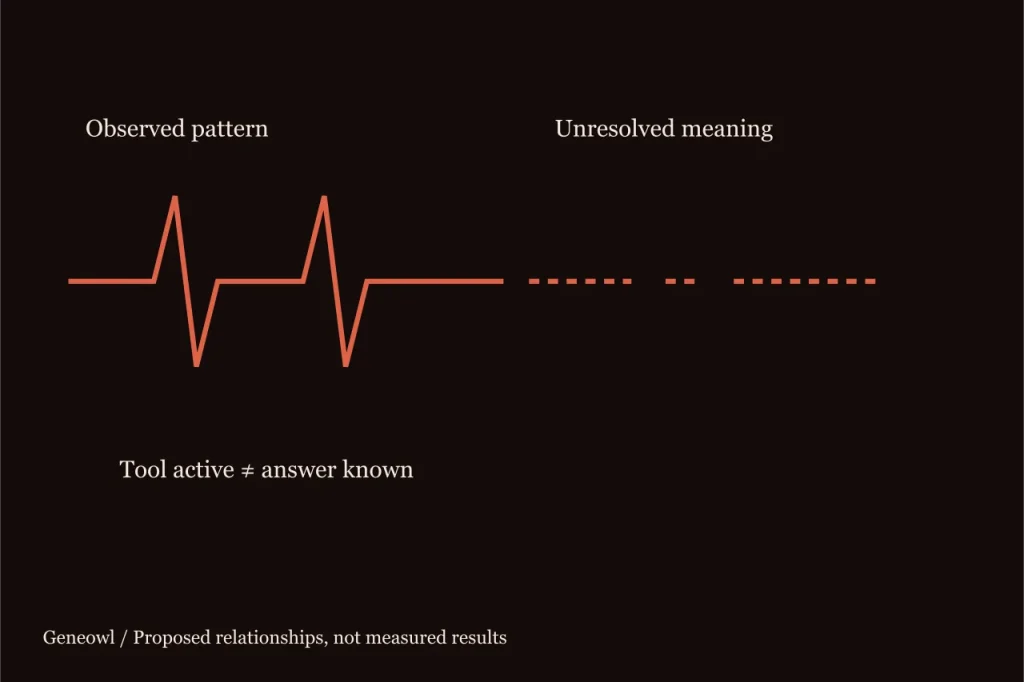
Root Signal proposes a character who can notice activity passing through a cultivated network. It would be easy to express that ability as a glowing trail leading directly to an objective. That shortcut risks making the sense feel like a conventional waypoint with organic decoration. A more useful starting point is to ask what the character actually notices. A surface may pulse in repeated intervals, change tension or produce a faint directional vibration. These observations can suggest a relationship without telling the player exactly what to conclude.
Separate detection from interpretation
Imagine a conduit that carries activity toward a sealed chamber. A sensory frill reveals recurring pulses near a junction, but the pulses alone do not establish whether the chamber is occupied or simply maintaining itself. The player compares that observation with a visible valve cycle and a quieter branch. The interface should preserve the original observation alongside any hypothesis. If later evidence contradicts the hypothesis, the earlier signal has not become a lie. It was a limited piece of information that the character interpreted under uncertainty.
Give repetition a purpose
A short sequence can teach the basic vocabulary without demanding memorisation of an elaborate code. One repeated pulse might accompany an open flow path; a broken sequence might occur while a junction is recovering. These are proposed fictional conventions, not scientific measurements. We would introduce them in a place where the player can observe an entire cycle safely. The second encounter changes one condition while preserving the rest. This lets a player recognise a relationship before the design asks them to apply it under pressure.
Colour cannot carry the whole explanation
A purple trace and a green trace may look distinct in concept art but become difficult to separate at a small screen size or for someone with a colour-vision difference. The signal needs another property: a line pattern, an interval, a small directional marker or a plain-language label. Motion should also have a reduced-motion presentation. A stationary sequence of marked states can communicate the same relationship without requiring a player to follow continuous flickering. Accessibility belongs in the signal vocabulary before the visual treatment becomes expensive to revise.
Explain silence without turning it into a fault
No detected signal could mean that the network is inactive, the tool is resting or the character is outside its useful range. Those states should not share one empty display. A small status sentence can identify the tool’s own condition while leaving the environment uncertain. For example, a resting sense can say that it is recovering, whereas an active sense can report that no pattern is currently detected. This distinction prevents the player from treating every absence as a secret clue or repeatedly activating the ability to check whether the interface has broken.
Keep ordinary observation valuable
The network view should not replace looking at the world. A visibly strained arch, a blocked maintenance opening or a person waiting at a junction can provide context that a specialised sense does not capture. In a proposed encounter, the shortest signal path may pass through a structure that cannot support the character’s weight. The player therefore combines different kinds of evidence. The ability adds a perspective rather than becoming a universal inspection button that renders every other interaction irrelevant.
Record the unresolved question
An observation notebook could store the junction’s location, the pattern noticed and a question the player chose to investigate. It should avoid converting a tentative interpretation into an authoritative quest statement. We have not validated this notebook in a playable build; the concept stage is the right time to make its assumptions explicit. See the Root Signal concept for the wider network investigation. The gripping-graft study applies the same principle to movement: a capability becomes interesting when its limits are visible enough to plan around.