
A City Grown Around Maintenance
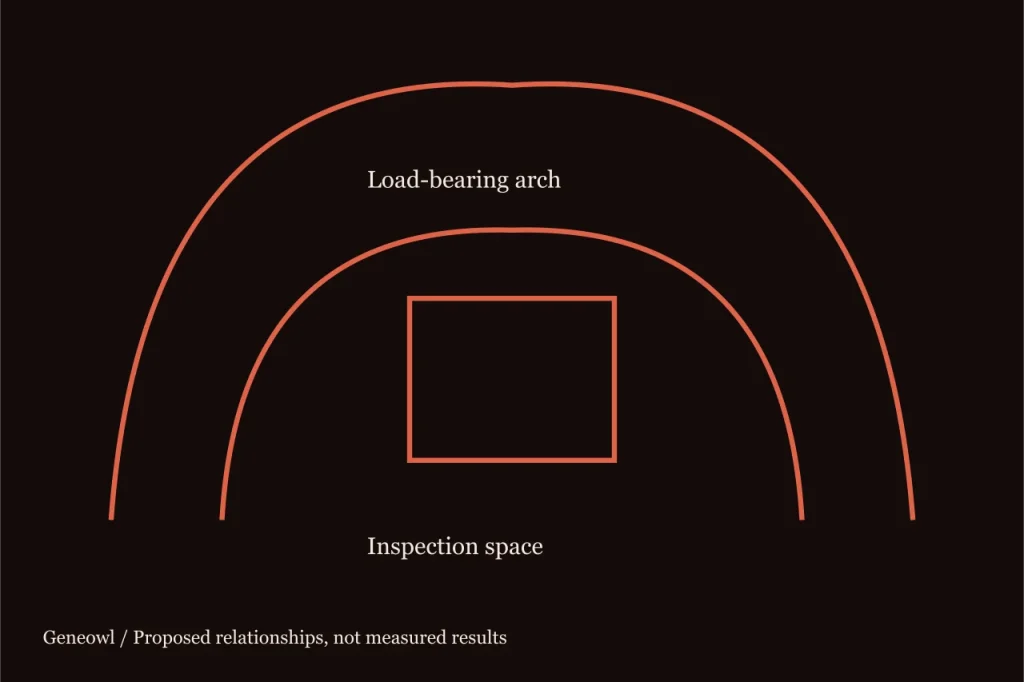
Start behind the impressive arch
An organic skyline can establish a world quickly. It can also hide the practical questions that make a place believable: how does a passage remain open, where does damaged material go, and who can reach the structure that needs attention? For Geneowl’s cultivated city, maintenance is a useful source of spatial detail. We are developing concepts rather than documenting a finished environment. This note follows a proposed street from its public entrance to the quieter service route behind it, looking for decisions that can support play.
Choose a load and trace its route
Suppose a flexible canopy shelters a market crossing. Its weight is carried by branching supports that meet the ground at several points. One support has thickened into a walking path, while another remains too delicate to step on. The art direction should make that difference readable through shape and contact with the surrounding surface. A player should not need to collide with an invisible wall to learn which part is structural. Distinct edges, worn surfaces and deliberate handholds can describe permitted movement without covering the scene in arrows.
Leave somewhere for an intervention
A repair opening needs working space. If every surface is dense with decorative growth, an important access point becomes indistinguishable from background texture. We would reserve a quieter patch around an inspection seam and let nearby paths lead toward it. The opening can then become a meaningful place for a conversation, a sample comparison or a decision about an attached tool. Visual restraint serves interaction here. The city feels cultivated because its growth is organised around use, not because every available pixel contains a vein or a glowing pore.
Show different ages of care
An old support may carry a smooth repair collar; a recent graft may be held by a temporary frame. These details can imply a sequence of work without claiming a specific historical event that the narrative has not established. They also help orient the player. A pale collar near the entrance and a dark frame above the service passage provide landmarks with different silhouettes. Repeating the same landmark everywhere would weaken that function. A route needs a small number of memorable relationships rather than a catalogue of equally loud visual motifs.
Keep the service route connected
The hidden passage behind the market should have an understandable reason to meet the public street again. Perhaps it follows the canopy’s support line and emerges beside a collection basin. A player using the service route can then recognise the underside of a structure previously seen from above. This spatial connection makes exploration more satisfying than a sequence of unrelated corridors. It also supports the branching approach proposed for Borrowed Skin, where different capabilities should reveal different aspects of a shared place rather than wholly separate levels.
Use a narrow view to answer a wide-view question
Our proposed home presentation pairs a broad city scene with a smaller detail. The detail should earn its space by explaining something in the panorama: the seam that allows a support to be opened, the texture that identifies a safe grip, or the frame holding a recovering passage. A random close-up of an organic object would repeat the mood without adding information. When the camera moves closer, the player should gain a clearer understanding of how one part of the city can be approached and used.
What needs checking next
The next concept review should ask whether the public route, service route and inspection opening can be identified in a small grayscale image. If the arrangement only works in a large saturated painting, it is not yet a reliable guide for a game space. The Living Tools overview connects the two proposed games. Read Root Signal for the network side of this city, or the Borrowed Skin dossier for the movement choices that determine which surfaces a runaway can safely use.